Story
Story 10
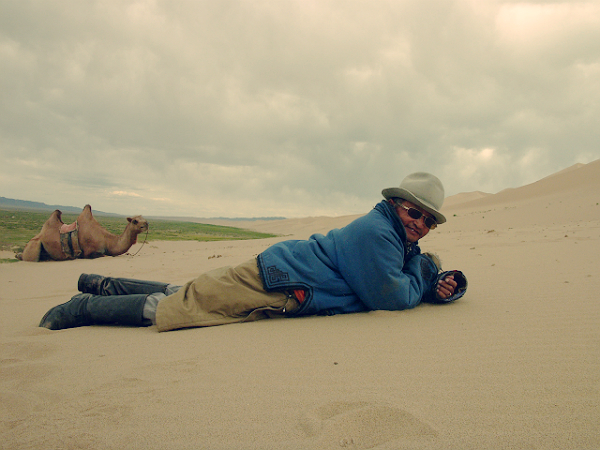
"I am telling you something about camel riding," he said.
He was regarded as one of the best camel riders in the Gobi.
We were having a break at a dune.
"A good camel rider knows how to ride fast and long."
I agreed.
"A great camel rider knows how to slow down."
He smiled.
"Most of riders think that they should save time and move fast as much as they can. They do not want to take a break."
He scooped up the sand and let it slip through his fingers.
The sand grains scatters in wind.
"Look at my camel. He does not care if he is busy or he is lazy now. He is just being here and content."
His camel looked up at the top of the dune, then closed his eyes and lied down.
"When people think too much about what they need to do just because they do not want to waste their time, I would say that they actually waste their peaceful mind by making themselves busy."
His voice was drowned out by wind sometimes, but I understood what he meant.
"Let's enjoy being idle and appreciate this moment like a camel does. Camels never get tired of being here without doing anything."
(photo & story by Tengyo Kura, The Gobi)
Story 9
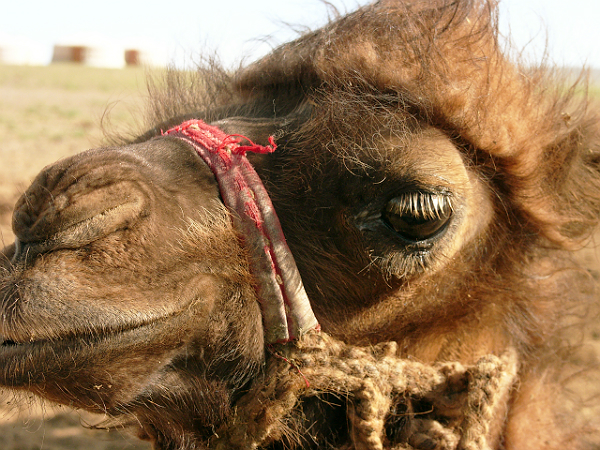
Look at this beautiful camel girl.
Her eyelashes are like tails of shooting stars.
Her hair stands like a sandstorm.
Her nose rises like a dune.
Her eyes reflect the sunlight.
And her color is like a stream after rain.
She represents all the beauty of the Gobi by her tiny body.
(photo & story by Tengyo Kura, The Gobi)
Story 8
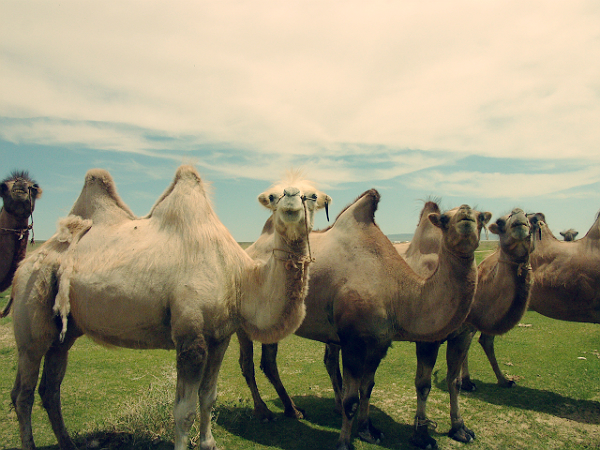
In a desert, camels are the most important livestock to the nomads.
Their body is beautifully designed to survive in the sever life condition.
People go everywhere by camel riding as camels are described as a ship in a desert.
Camels provide not only a transfer, but also wool, milk, and meat.
Since I saw a movie called “The Story of the Weeping Camel” (2004, directed by Byambasuren Davaa and Luigi Falorni), to meet a white camel became one of my dreams.
Actually, there are many white camels in Mongolia, and the Mongolian people do not take care of them as special ones against my imagination.
It was just my myth.
Anyway, my first encounter with “tsagaan temee” (a white camel in Mongolian) was the day when a sudden rain created a rivulet after a long spell of hot weather, and I was of course happy.
(photo & story by Tengyo Kura, the Gobi)
Story 7
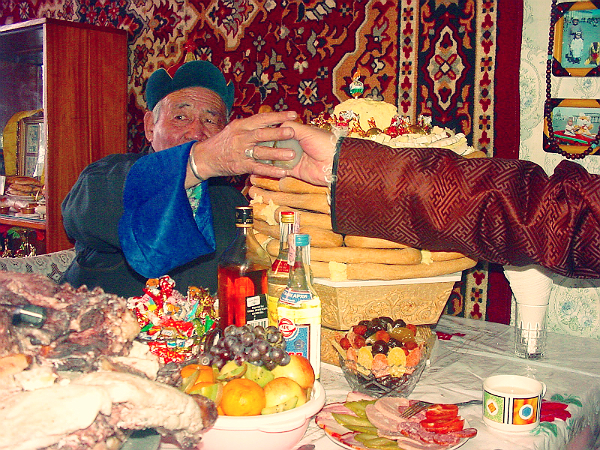
Tsagaan Sar (White Moon in Mongolian) is the Mongolian Lunar New Year, and the biggest holiday of Mongolia.
People dress traditionally and visit their families and friends all day long.
They make hundreds of thousands of BUUZ (Mongolian steamed dumpling filled with meat) and treat their guests.
On a big table in the main room, Mongolian bread, sweets, and the most importantly, a whole sheep meat (already boiled) are put and decorated.
People usually prepare the sheep meat in small parts, and build them together and form a sheep shape on the table.
One day before Tsagaan Sar, I came back from work, and looked for meat for my lunch.
I was very hungry, and without paying attention I just grabbed one piece of sheep meat from a freezer.
In the kitchen there was a brother of my Mongolian mother (I was living with my Mongolian father and mother), and I slightly noticed that he seemed startled by what I was doing.
Because I was so hungry and determined to cook, I ignored his reaction and began to cook.
Until I finished my lunch, he did not say anything, so I did not care what he might have wanted to tell me something.
In the afternoon, when I went to the bathroom, I saw my Mongolian mother exploding with anger.
Her face was literally in red.
Next to her, her brother was sitting uncomfortably and her son was laughing out loud.
Her son, my Mongolian brother joyfully said "I have never seen such a funny thing!"
Yes, what I ate was the most sacred part of the ceremonial sheep meat.
My Mongolian mother had to go to market and get a new piece, but the New Year was over peacefully after all.
In the photo, two men were exchanging their bottles of snuff to show their trust and loyalty to each other.
(photo & story by Tengyo Kura, Ulaanbaatar)
Story 6
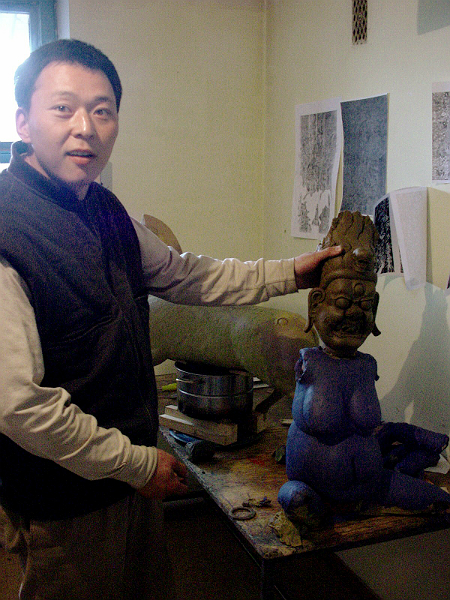
When I lived in Mongolia in 2003, people randomly grabbed a private car as a taxi.
They negotiated a fare which was rather reasonable.
One evening I caught a private car on the street in front of a local restaurant.
The driver of the car was Tulgaa.
In those days it was not usual to meet a Mongolian who spoke English well, but Tulgaa talked to me in good English.
He was happy to meet a foreigner because he liked to use English.
I asked him what he was doing, he told me that he was a traditional Mongolian sculpture.
We became good friends and he invited me to his workshop one day.
Showing me his work, he told me why he was doing that.
Mongolian major religion is Tibetan Buddhism.
There are many Tibetan Buddhist temples in Mongolia.
During the puppet government of Soviet was formed in 1930's, so many temples were destroyed and countless monks were killed.
Then Soviet Armed Forces came to Mongolia, and stole valuable statues and other treasures from the destroyed temples.
They sold those important historical materials in Europe.
What the Soviet army stole and sold included documents that explained about sculpture production of temple statues.
Since then there was no way to learn how to build the statues in current Mongolia.
Tulgaa and his brother wanted to revive the traditional Mongolian sculpture.
Tulgaa's brother moved to Netherlands, and buys any documents and materials that can be a reference at markets and auctions, then sends them to Tulgaa.
Tulgaa learns the reference and reproduces temple statues in the same way as old Mongolian sculptures.
"I don't want this beautiful culture to die. And new temples need statues. We must continue our project," Tulgaa said.
I was fortunate to catch his car in that evening.
(photo & story by Tengyo Kura, Ulaanbaatar)
Story 5
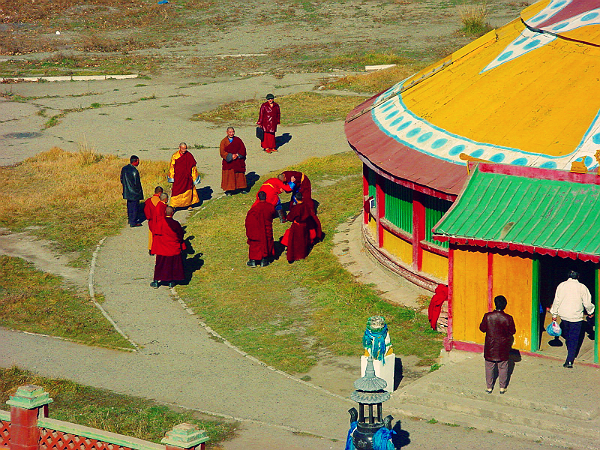
In front of where I lived in Ulaanbaatar, there was a beautiful temple.
Young monks often enjoyed Mongolian wrestling outside.
In the late afternoon people going home stopped by and offered a prayer.
It was my most relaxing time when I came home after my teaching at a university, having Mongolian salted tea and watched people from the window.
I saw people's daily life every day, and every time I was moved to realized that I was in Mongolia.
Sometimes people asked me why I love Mongolia so much, but I could never explain well why.
Mongolia's major religion is Tibetan Buddhism.
Reincarnation is one of the most important elements of the religion.
I do not know if reincarnation is true, but if so, then my previous soul was in Mongolia.
I cannot find any better reason of my attachment to the beautiful country.
(photo & story by Tengyo Kura, Ulaanbaatar)
Story 4
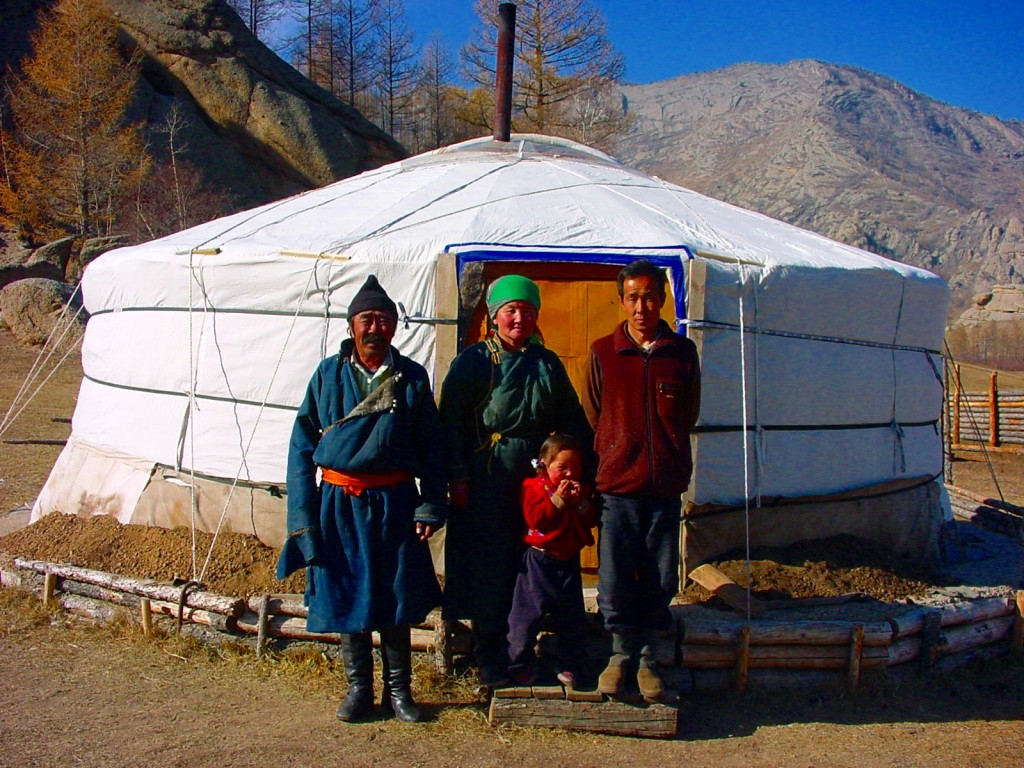
In Mongolia, there is a saying “an unexpected guest who visits at mealtimes brings luck.”
It tells that you should welcome any visitors and feed them even when you don’t like.
This is the wisdom of the nomads.
In their culture, sharing food is the most important tradition which helps people survive under the harsh climate.
When I suddenly came to this local family’s house in the countryside, they offered me sweets and tea even though they were about to receive their important guest then.
(photo & story by Tengyo Kura, Terelj)
Story 3
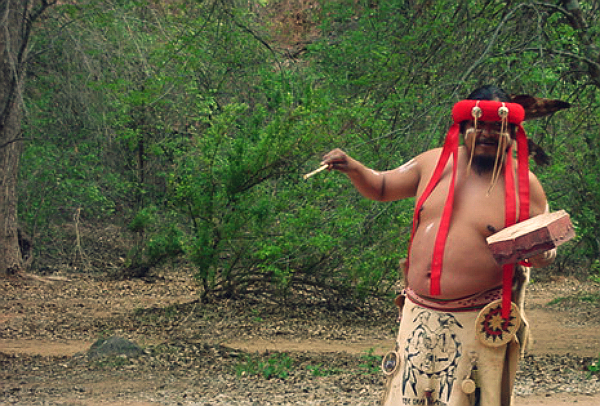
One day I made up my mind to go to a Native American reservation for the Havasupai tribe located at the bottom of Grand Canyon.
I parked my old blue mustang at Peach Springs, the gateway to the reservation and walked down to the bottom of the canyon.
It was about 10 KM to the reservation.
The route is very rocky as if you were walking on Mars, you can easily lose your balance and fall on unstable small rocks.
The heat on the way is unbearable (depends on the season), you need a lot of drinking water, and need to find a shade to have a break frequently.
The most challenging part is that you should arrive the reservation before sunset.
It is the bottom of the huge canyon, the sunlight hour is short.
After sunset the path is in the dark and it becomes very difficult to walk safely.
It took me about five hours to the reservation with stopping by for resting and taking photographs.
You can hire donkeys or horses from Peach Springs, by the way.
Once you have arrived at the reservation, you proceed to a camp site where beautiful green and water await.
I had never imagined that there was so much green and water nurturing various creatures at the bottom of the canyon.
On the way from the camp site to a local grocery shop you can see some of the most beautiful waterfalls in entire USA.
At that time two of the waterfalls in the reservation were enlisted on the top 10 beautiful American waterfalls.
The color of the waterfalls were truly breathtaking.
Greenish blue water reminded me of my mustang (the color of my mustang was turquoise blue).
I usually felt happy to be home again when I came back to LA from my long road trip.
Because the days in the reservation was amazing, probably it was the first time that I was a bit sad when I saw the city of Los Angeles with lots of buildings and artificial lights when I returned.
(photo & story by Tengyo Kura, Havasupai)
Story 2
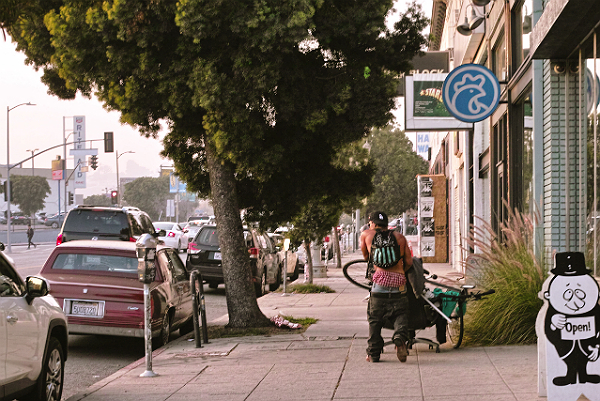
When I was walking down Sunset Boulevard after checking some guitar shops along the street, I heard a faint singing voice behind me.
I was coming to a big intersection, the traffic was busy.
Seeing many cars passing me, I realized that it was not a singing voice but a shout.
"AAAAAAAAAAA!"
The shout was approaching me rapidly, I was surprised and turned around.
It was an African American woman fiercely running with bear feet swinging her hair.
She ran past me and entered the big intersection at once.
"AAAAAAAAAAA!"
I was stunned and looked at her crossing the intersection without being hit by any cars.
All that happened within ten seconds.
Hearing her shout fading away, I felt like I witnessed some kind of human miracle which says: When you are hyper enough, you are invincible.
(photo & story by Tengyo Kura, Los Angeles)
Story 1
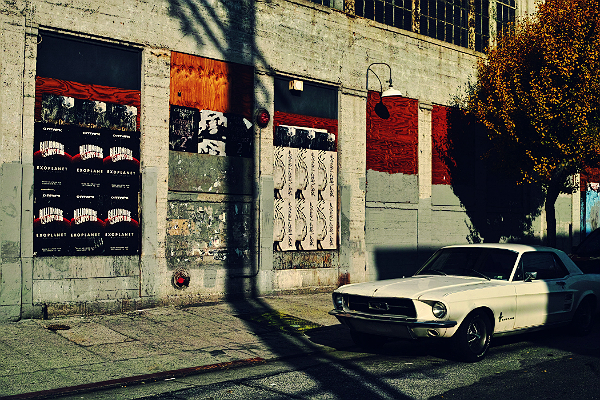
When I was living in USA, I got a 69 blue mustang. (this white mustang is somebody else's)
We made so many road trips together through 15 states.
Once from LA to Vancouver (I reached Alaska and the arctic circle afterwards with a rental 4x4 truck), once from LA to Miami.
It was equipped with a simple straight six, and easy to fix.
It rarely broke, when the brakes didn't work on Olympic Boulevard was one of the few serious problems I still remember. (I managed to stop the car by entering a side road and shifting down then pulling up the parking brake with my full strength)
Another problem I remembered is when the engine didn't start at a very cold winter night in Arizona.
It was my first road trip in USA, I drove to Grand Canyon.
On my way I stopped by at a town called Tombstone, and parked my car at a shop to buy some food.
After shopping, the engine of my car didn't start, and I couldn't find a cause.
So I decided to stay over night at Tombstone and to wait for a morning to try again or call AAA.
I booked an inn and went to a bar for dinner.
A waitress of the bar told me that there would be a Christmas party held at a town hall and town people would gather and I should go as well.
I went to the party and met the mayor of Tombstone.
He saw me and asked me where I was from, then he held a small ceremony to make me an honorary guest citizen of Tombstone.
That was an unexpected Christmas gift for me.
That event happened because my blue mustang didn't want to go at that night. (in the next morning the engine started as if nothing had happened the night before)
Before reaching Grand Canyon, I passed the reservation of White Mountain Apache in northern Arizona.
When I pulled over my car and checked a map, one black truck came and stopped beside my car.
"You've got a nice car," a driver opened the window and said to me.
"Thanks," I smiled at him.
"Where are you going?" he asked.
I saw two more people in his car smiling at me.
"To Grand Canyon," I also smiled at the two passengers.
"Shall we get out of our cars and talk?" the driver suggested.
So we parked our cars in an empty space nearby and greeted to each other outside the cars.
"Where are you going to stay tonight?" the driver asked me.
"Well, no plan," I replied.
The three native Americans were talking to each other a bit, then the driver said.
"You know what? You look identical to my young brother who passed away a few months ago. Please stay at my place tonight. This must be the fate," he looked me in his eyes.
I spent two nights at the reservation, did fishing, shooting, and eating game meat together with the Apache people.
The experiences with the native Americans were mind-blowing to me.
Before I met the native Americans in Arizona I only focused on learning martial arts in the States, and I did not see other opportunities that might have had enriched my life.
Now I saw a lifestyle I had never imagined, and I learned cultures I had never experienced.
Suddenly I felt that my horizons were widely opened and the limit of my imagination was removed.
It's said that we can realize anything we can imagine.
If it's true, then to meet new people and to experience new cultures make one's life rich and fun.
I realized that it was much more joyful for me to discover cultures and to dive into them than to keep fighting and competing in martial arts world.
The word "fate" which the man who invited me to his place used was actually true.
It was the fate that my way of vagabondism began at the moment I met the three native Americans.
Again, thinking back when my car didn't start at the night in Tombstone, every timing changed and I would not have had met the Apache people, then I might not have had become a vagabond.
After traveling together for a bit more than two years in USA, I gave the old blue mustang to my martial arts teacher as a token of my respect and appreciation to his teaching when I left the States for Mongolia.
He insisted me to receive at least one dollar, so I accepted.
I still have the one-dollar note with "Thank you" written by my martial arts teacher on it.
(photo & story by Tengyo Kura, Los Angeles)