
Story
Story 130
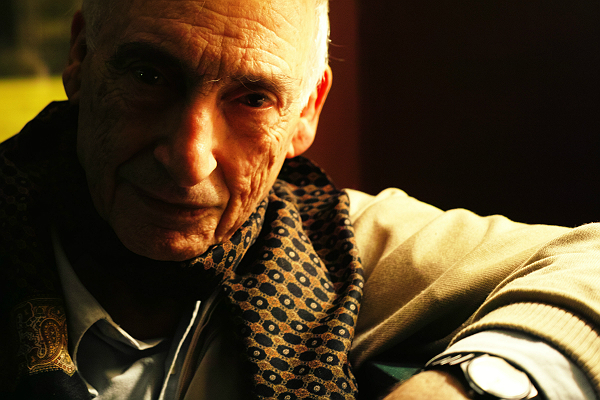
When I looked for a good play, and entered a small lovely theater with a red door in Buenos Aires in the end of 2015, he opened his arms and welcomed me with full of affection.
Without knowing who he was, I felt something special within him.
He, Igón Lerchundi was a legendary pioneer of the art of miming in Argentina and Latin America with his life-partner Roberto Escobar.
Igón and Roberto opened their miming theater in Buenos Aires in 1973, since then they had received performing students from all over the world.
Being ignorant about Igón's achievement, I started visiting him only because I liked him.
He usually took me to a cafe nearby, bought me a cup of coffee, then asked me many questions.
At that time my close friend just passed away, I confessed my sorrow and emptiness.
Igón told me that even at the darkest moment in life, somebody would be a star and light up my life again, so I should not lose hope for life.
Igón himself had lost countless precious people through civil and world wars.
When we became close friends, Igón let me stay at his room where he modified his theater attic for our coffee time.
Igón's partner Roberto was on the edge of death then, they lived in their theatre to stay together at Roberto's final days.
I was honored to meet Roberto also while I was visiting Igón.
One day in his room Igón asked me to do miming.
The subject was to lift up a heavy stone from the ground.
I felt shy to do it since I knew nothing about miming, but I had no choice, I tried to imagine a big rock on the floor, and imitated to pick it up.
I still remember how embarrassed I was because of my cheap self-conscious.
Igón simply said that he didn't see me suffering from the weight of the stone I held.
Then he stood in front of me, and showed me his miming.
I don't forget the moment till I die.
The time became still, the atmosphere was profound.
I felt that I was seeing all the history of Igón's life in his short miming.
Igón told me that when I came back to Buenos Aires next time, he would teach me how to move my body.
That was our last conversation.
Now, a great performer, a great teacher, and a great human-being of love and passion, Igón Lerchundi has gone to where his soul partner Roberto awaits.
I could not make it to be back in Buenos Aires before he left...
Igón, I miss you so much.
I miss our conversations at the friendly cafe nearby your theater, on the old street of San Telmo, at your inspiring attic chamber.
I still want you to be at the theater and to welcome me by hugging and kissing me fondly.
But I know that I should be grateful for our meeting in life, and I should not be sad about our parting. As you said when you lost Roberto, "it's not a good-bye."
You enjoy your reunion with Roberto in the another world now, and I'm glad about that.
I will keep practicing my miming of picking up a heavy stone to impress you when we meet up next time where you are.
At that time I hope that my cheap self-consciousness will be gone and my miming will be only companied by joy.
Maybe it was a message from Igón; to pick up an invisible heavy stone is like to feel the weight of one's life.
Am I mature and wise enough to feel it?
Am I brave and strong enough to lift it and hold it by myself?
Nos vemos, mi mentor, mi amigo, mi inspiración.
Eres una estrella que ilumina mi vida.
Con mucho amor y respeto.
(photo & story by Tengyo Kura, Buenos Aires)
Story 129
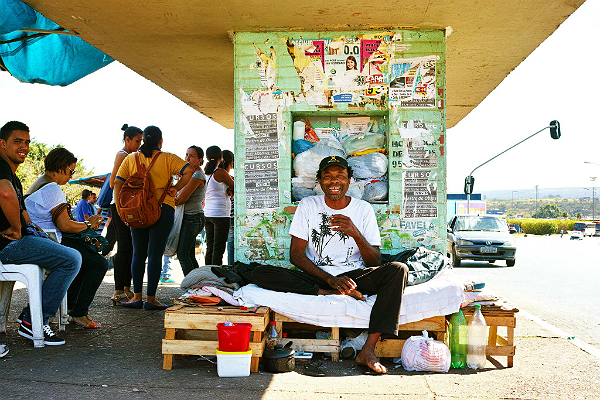
“Brother, as long as you can smoke and sleep anytime you want, this small bus stop can be a nice house of yours,” saying so, he laughed out loud, and lit his cigarette.
He used old notebooks that he picked up from somewhere for rolling a cigarette, so some numerical formulas or diagrams were seen on his cigarette sometimes.
Obviously he did not care about that.
He had nice stuff to live comfortably on the street like homemade pickled vegetables.
One day, he sang a song for me.
It was very beautiful, and melancholic melody.
I did not expect such a delicate singing voice of his since he always laughed with his deep voice.
He told me that the song was from his hometown.
I understood that he did’t sing in Portuguese, but could not know what language it was.
Well, it might not be important to him.
He was content with his life at the bus stop anyway.
Recently I found that he left the bus stop.
I was worried, and I asked people at kiosks behind the bus stop what happened to him.
It could be that the police removed him, or he became sick, or somebody attacked him…
But according to the kiosk workers, he moved because there were too many people using the bus stop all day long nowadays, and he could not sleep well anymore.
I laughed (not like him), and imagined him humming and rolling a cigarette at a corner of somewhere in this town.
He might be saying to somebody “brother, this corner can be your nice house!” and laugh out loud right now.
I hope you can sleep well there, brother!
(photo & story by Tengyo Kura, Brasilia)
Story 128
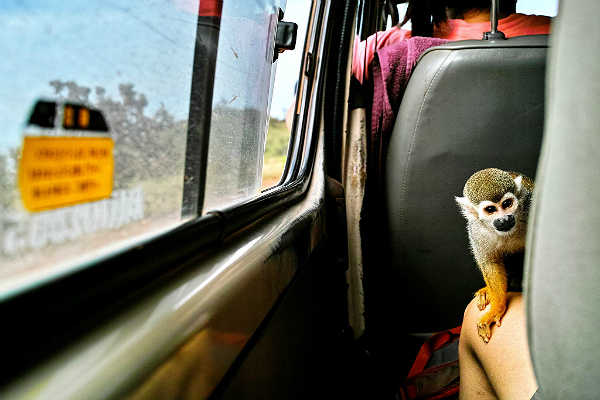
We were 17 people heading to the border between Guyana and Brazil.
We were like shipmates of this 18-hour bumpy ride through the jungle where we had to remove big branches from a path sometimes.
We were from different backgrounds and we were on different moments of life.
One indigenous girl hopped onto our van when we stoped by at a petrol station.
All the passengers were surprised because she was working at the petrol station and she filled up our van just a minute ago.
She smiled and told us that she had suddenly decided to quit her job and go home in the depth of the jungle when she saw our old Toyota coming in.
I told her that I was honored to be with her at the moment she made a big change in her life after three years working and living in a city.
On the way when the van was already full, our reticent driver picked up a big family who was going to a church far away to meet a famous priestess.
A father of the family was holding a big electronic keyboard which almost squashed his children in a jam-packed car.
At the last part of our trip, we even got a monkey...
We had different missions and future plans nevertheless we had sat in the same car pushing each other for all night long to reach the same destination.
It made me realize that this little bit of our life moment we shared was unconditionally priceless to me.
(photo & story by Tengyo Kura, George Town - Boa Vista)
Story 127
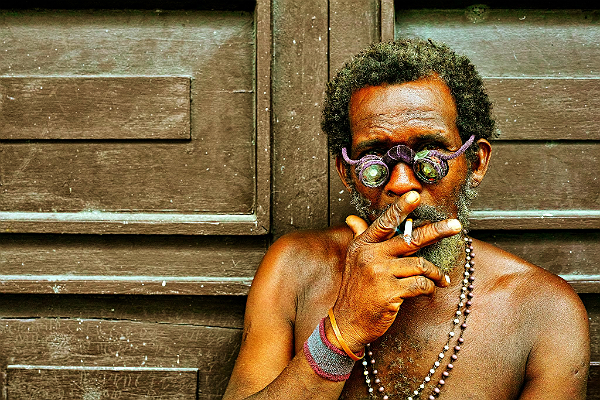
The man was usually sleeping on a street right behind the central post office of Georgetown, Guyana.
When I saw him for the first time, my eyes were immediately glued to his funny glasses.
They were funny, but suited him very well, and made his presence so unique.
One day, he was unusually awake when I came along the street.
Since I was very interested, I could not stop myself talking to him.
“Excuse me, could I take your photo?”
He did not understand my question, and asked me back.
“You mean you want me to take your photo?”
“No no, I would like to take your photo.”
I smiled and replied.
“My photo? Why?”
He was a bit confused, but showed me a nice smile.
“Because your eyes are beautiful,” I told him.
Yes, he had really beautiful eyes, and I certainly caught the moment when his eyes met mine through his special glasses.
After I took his photo, I asked him a silly question just out of curiosity.
“Do you see well with those strange glasses?”
Smoking his cigar with a content look, he answered to my question gently.
“Glasses are not only for seeing things better, but also for not seeing things too much.”
He smiled, and lay down.
The usual scene came back.
I thanked him, and left there.
While walking away I thought I was going to remember this fortunate meeting with the wise man of beautiful eyes for a long long time.
(photo & story by Tengyo Kura, Georgetown)
Story 126
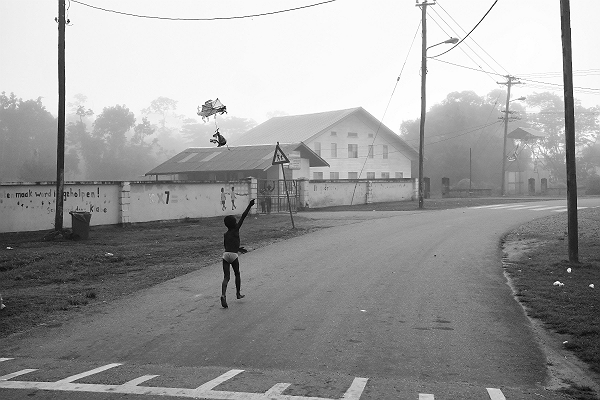
"What are you doing here?”
The boy asked me wonderingly.
He might not have seen outsiders so often.
"I am looking for something interesting here,” I replied.
"What is that? Is it here?” he seemed confused and asked.
"I don't know actually. I even don't know what is interesting to me.”
I shrugged my shoulders and answered.
The boy said "hum," and began to run with his kite in a morning mist.
Without looking back at me, he shouted "If you want something interesting, a kite is good. It's fun!”
(photo & story by Tengyo Kura, Klaaskreek)
Story 125
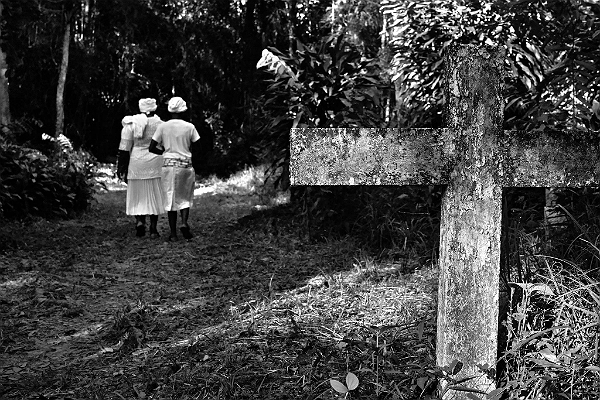
One day, I was at a funeral in the countryside of Suriname.
To pay respect and love to the departed young woman who loved dancing and singing, the village people carried her coffin colored pink with songs and steps on the way to a cemetery in a forest.
The villagers kept singing together while the woman was buried in the earth, and they continued even after that.
The singing voice of the mourning people was reflecting among woods, and winds took them into the sky.
One villager told me that the souls of departed people in the forest would not be sad because the trees could sing lullaby for them.
"The trees had been listening to people's songs dedicated for the deceased at every funeral, so they remembered all the songs now," the villager continued.
(photo & story by Tengyo Kura, Klaaskreek)
Story 124

After taking an overnight bus, I was watching a river in a morning mist.
The river told me that here the land of Brazil ends, and the Highlands of Guiana begins beyond.
Boats were sliding on the water soundlessly, the air was simply tranquil.
"Wind knows where to blow, water knows where to flow. You don't need to know where to go, just be free as you were born free."
A saying of an old vagabond crossed my mind.
(photo & story by Tengyo Kura, Oyapock)
Story 123

Macapa was my gateway to Guiana Highlands.
Six rivers, eight buses, six boats, four borders.
When I was reaching Macapa in the early evening, Amazon River showed me its majestic figure.
It is a fact that the sun is going to start dying in 55 billion years, and Earth is going to be like today's Mars then.
This great river should disappear much before the end of the sun and the solar system.
Nothing is eternal.
Seeing the magical view in the evening light, I strongly felt that how fortunate it was to be able to see Amazon River while I am alive.
(photo & story by Tengyo Kura, Macapa)
Story 122
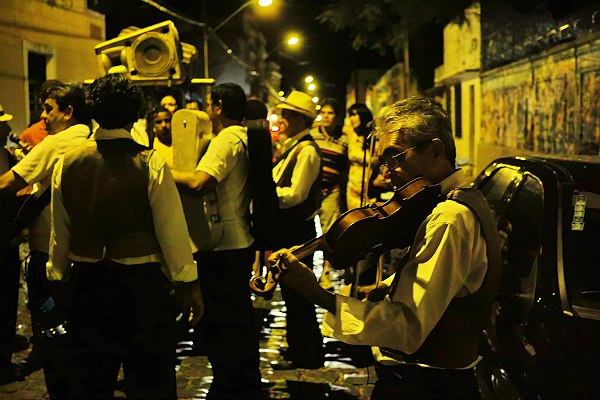
Olinda is a beautiful vintage seaside town.
There are many colorful houses standing along tasteful stone-paved alleys.
Culture schools can be found in every single neighborhood, the locals from small children to elderly people learn dance, music, and art daily.
Youth play football on the beach, practice boxing and gymnastic in a park, play samba music at cafes.
Lovers enjoy their moment at sunset by the sea.
Every Friday night, local musicians gather and parade through the town.
One time I followed the band, it was such a pleasant evening.
So good music and so many smiles.
After the parade was over, I talked to one of the musicians.
"What a beautiful night. Thank you for the good music."
"Oh, thanks for your being our company," he smiled and replied.
Because I had truly a good time, I allowed myself to ask him a cheesy question.
"What does music mean to your life?"
He seemed a bit surprised by that, but cheerfully answered to my question.
"Well, when my life is a happening, music is a meaning to it."
"Hey guys, buy some drinks! The night has just begun!"
A friendly woman at a bar on the street called us.
I still cherish a memory of the wonderful evening at a beautiful town.
(photo & story by Tengyo Kura, Olinda)
Story 121
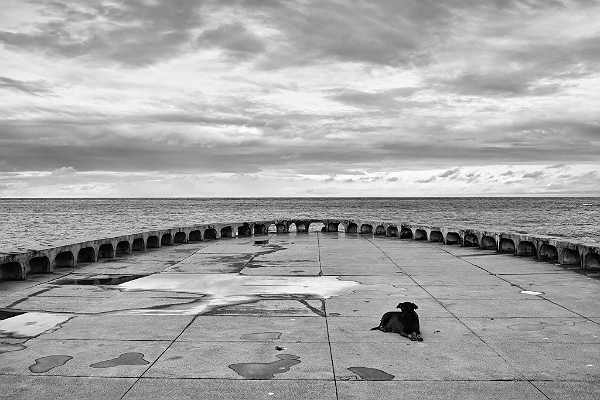
Dog: So kid, I assume that you must have heard of me from your great grandparents.
Me: (Kid??) ...No.
Dog: Okay, then your grandparents must have told you about me. Yes?
Me: ...No.
Dog: ...I see. But then you must have learnt about me at school, didn't you?
Me: (What on earth is this dog talking about?!) ...No, not at all.
Dog: (What on earth is this guy learning in his life?!) So you know nothing about me?
Me: No. Excuse me, but can you tell me who the dog you are?
Dog: Well, then... I am the world's famous Atlantic Dog who you can meet only at the Atlantic Coast.
Me: What?? Seriously?! Is this the Atlantic Ocean I am seeing now?!
Dog: Yes, kid. You are now seeing the world's famous Atlantic Dog.
Me: Wow!! I finally reached the other side of South America after 8 months!!
Dog: Yes, you finally reached me after your whole life.
Me: Hurray!! I made it, I made it! (dancing and leaving the dog)
Dog: Boy, now I feel sick as a dog... (face paw)
(photo & story by Tengyo Kura, Olinda)