Story
Story 30
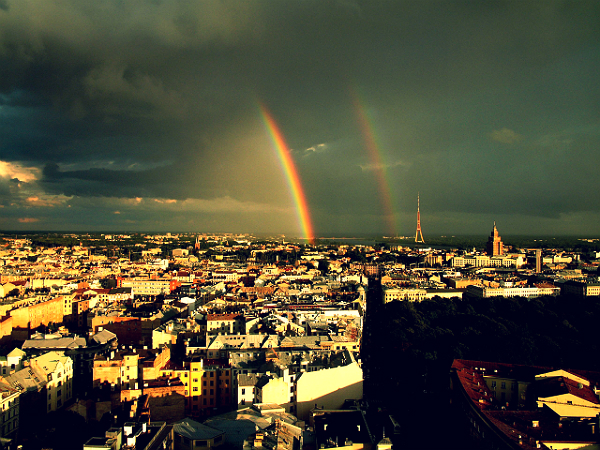
When I moved to Riga, the capital of Latvia, I had no idea how Latvia was like.
I had a couple of Latvian students in Norway, they were very gentle, artistic, and inspiring.
Later I was going to discover that they were actually the typical Latvian people.
Riga was one of the most beautiful cities I had ever been.
At every single corner of Riga I could encounter an inspiring moment.
Riga had been my muse for one year and half.
Looking back, the double rainbow I saw a few days after my arrival was not only the celebration but the indication of our following beautiful partnership.
(photo & story by Tengyo Kura, Riga)
Story 29
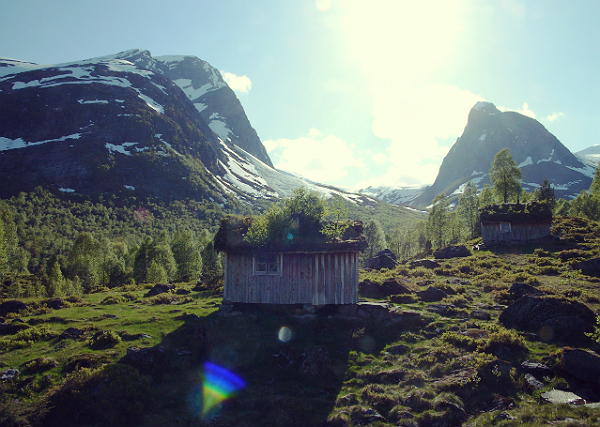
"How is it like to grow on a roof?"
I asked the little tree rooting on the roof of an abandoned shed.
"It's good, a little bit unstable when strong wind blows, though."
The small tree replied.
Bunch of trees on the ground giggled and swayed behind the shed.
"How do you feel up there, big brother?"
The little tree asked a taller tree growing on another shed's roof nearby.
"Oh, I like it! I get closer to the sun than other trees on the ground. I feel like I am the tallest tree here."
The taller tree happily answered.
The rest of the trees on the ground again giggled and swayed joyfully.
"So, how do you feel having not taken root on anywhere and being cast away by wind always?"
The little tree asked me.
"Not too bad. If I hadn't been cast away by wind, I would not have had reached here and met all of you now."
I replied and smiled.
The little tree, the taller tree, and all the rest of the trees on the ground smiled and swayed joyfully.
The sunlight of late summer was falling upon all of us brightly.
(photo & story by Tengyo Kura, Møre og Romsdal)
Story 28
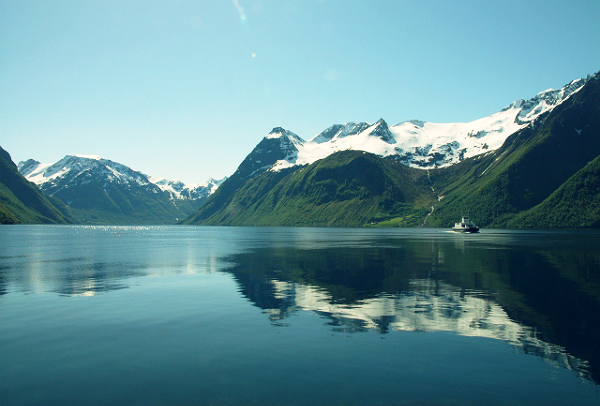
I loved fishing in a fjord in Norway.
My friends rented a boat and invited me for fishing sometimes.
Norwegian fjords are extremely deep, some parts are more than 1000 m deep.
Because fjords are extended ocean coming far inland, usually the surface of water is very calm.
I always felt like I was not on the sea but on a lake when we fished in fjord.
Dolphins accompanied us quietly.
Clouds were drifting slowly.
I didn't mind if I caught fish.
The peaceful moment I spent with my good friends was priceless.
And when we had brown-cheese sandwiches for our lunch on the water, it was just perfect.
(photo & story by Tengyo Kura, The Geiranger Fjord)
Story 27
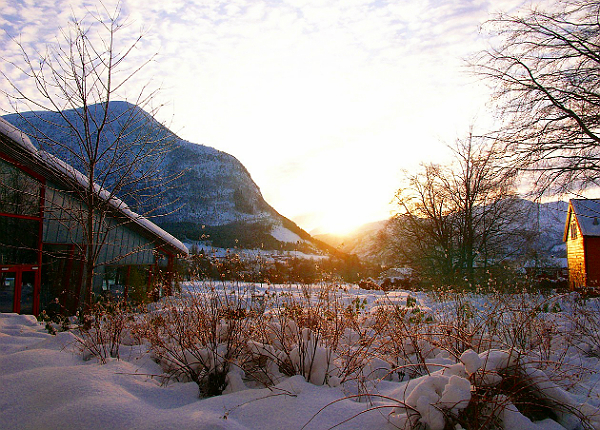
Norwegian winter taught me how beautiful feeling it was to wait for spring.
Even tiny little plants gave me a big joy when they came out of the snow.
I learned to appreciate small changes in nature as a sign of spring's approach.
Every day snow reflected sunlight, candlelight, and moonlight beautifully and healed my spirit to be ready for the season of the bud of life.
Winter in Norway showed me the importance of walking towards a change step by step.
(photo & story by Tengyo Kura, Volda)
Story 26
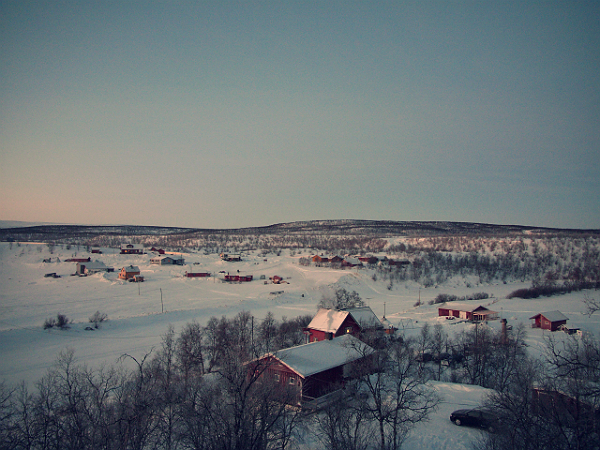
Kautokeino has about 3000 inhabitants today.
This place is the center of the Sami culture.
There are many cultural and educational institutions including Sami University College and the Sami Language Committee in Kautokeino.
When I stayed at my student's home, his mother was a director of the university college.
I was privileged to visit the school and to be treated a nice hot cup of coffee at the canteen when it was about -30 degrees Celsius outside.
My student's father told me that the temperature once dropped to -50 degrees Celsius in 1999, and many reindeers died even though reindeers are durable against extreme cold.
When my student and I went out to visit his relatives, he ran on the snowed ground like a wind.
He wore a reindeer skin which protects him from freezing air.
One day his sister wore a traditional Sami costume called Gakti for me.
The vivid colors of blue, red, and yellow on her dress should be visible in every season in nature.
The dress can tell if the person is married or not by the shape of buttons on a belt.
The family of my student served me reindeer meat one evening.
It was probably the best meat I had ever had.
The family told me that reindeer meat is the most healthy among land animals' meat.
I was so fortunate in having them as my host family during my stay in Kautokeino.
They introduced me the life of Sami with full of hospitality.
On the last day of my stay, I found a small heart-shaped lump of snow outside.
Maybe it was a hint that I might return to Kautokeino someday.
(photo & story by Tengyo Kura, Kautokeino)
Story 25
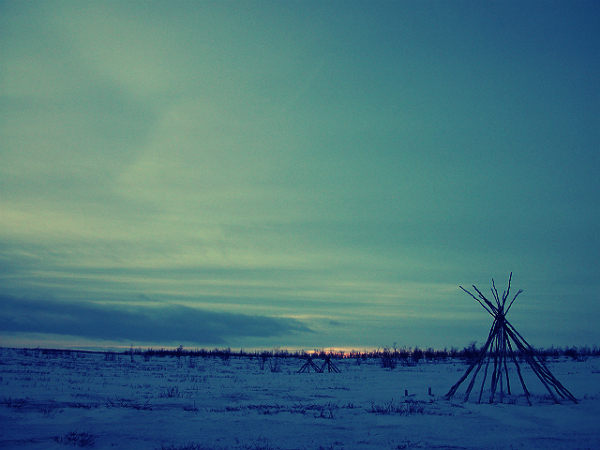
The Sami culture reminded me of the Mongolian culture.
They both believe in that natural objects possess a soul, and the nature world is created by deities and spirits.
Both of them worship the departed souls of humans and animals.
The Sami venerates spirits of bear and reindeer as the Mongolians respects wolf's soul.
Especially in the Sami beliefs, the departed continues to exist in the underworld, and the living and the departed communicate as they are from the one family.
When I was watching the sun setting over the horizon, strong winds blew and I heard a distant sound of cowbells.
I felt that it was like a wind carries a message of the living world to the underworld.
Then how a message from the underground would be delivered to the living world?
This is only my imagination, but when aurora appears in the sky, sometimes we hear something like a rumbling of the earth.
I assume that it could be a message from the underground.
Too much fantasy?
The Sami has a saying which goes: Do not let children play under the northern lights. The northern lights will take them away.
So why not?
(photo & story by Tengyo Kura, Kautokeino)
Story 24
One winter, I was wondering where I should be during the winter holidays.
I had not been traveling in Norway much, because where I was living had everything of Norway; mountains, fjords, traditional houses, kind people, rich culture, and simple good food.
I decided to visit any places for satisfying my curiosity.
I had thought about that for three days, but I could not find my destination.
On the fourth day, suddenly one image struck my mind while I was drawing randomly at home.
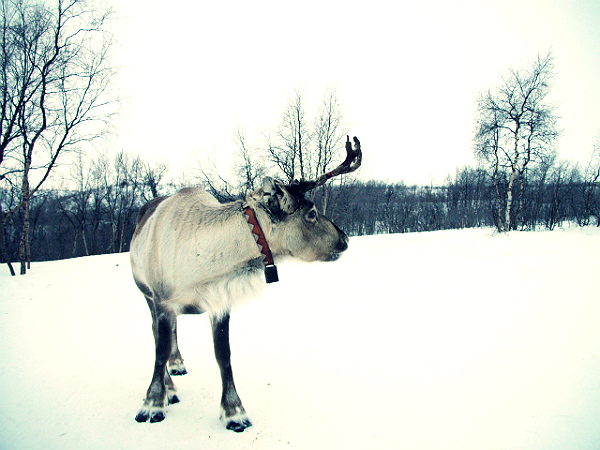
That was a reindeer standing alone in a grove in a pale glimmer of moonbeams.
I stopped drawing, and started searching where I could find reindeer in Norway.
The arctic circle was the place I needed to go.
Far north, the land of the Sami people.
Fortunately I had a student who is Sami, so I asked him if I could stay at his place during the winter holidays.
He was glad to receive me with his family in Kautokeino.
I put all of my winter clothing in my luggage and flew to the Sami land.
My student's house was very modern and warm.
The family was very kind and communicative with me.
They respected the Sami culture, and they taught me the history of the Sami.
In the end of 19th century, immigration of the Sami people to Alaska began encouraged by the US government.
My student's ancestors went to Alaska then in order to teach Inuit how to live with reindeer.
On the first day, I did not see any reindeer.
At night of the second day, when I came back home from my northern light watch, I saw two small round lights in a bush in front of my student's home.
That was the eyes of a reindeer reflecting my flashlight beam.
I stopped there and stood still for a while.
The scenery was similar to the image I got before.
It was like I was in a fantasy tale.
With excitement I told my student at home that I saw one reindeer just outside his house.
He said that it was his family's pet reindeer.
"He came home to sleep," he continued.
I felt shy that I was a bit too much fantasizing in my own imagination.
"Welcome to the Sami land," he smiled at me.
(photo & story by Tengyo Kura, Kautokeino)
Story 23
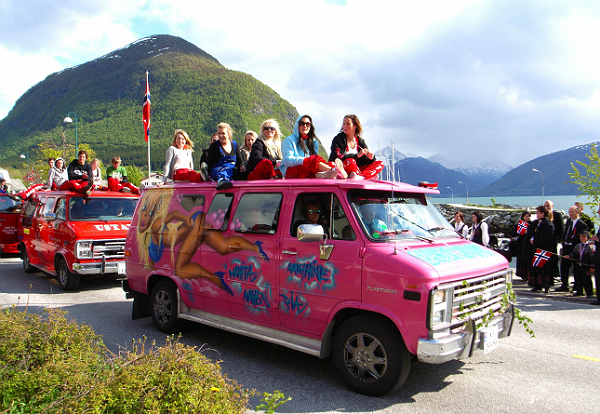
Russ celebration is the long-standing tradition of Norway.
When senior students at secondary schools come to the last spring semester they celebrate in typical Russ costumes (usually red, blue, or black overalls) for about three weeks until May 17th, the Norwegian Constitution Day.
There are various things Russ students enjoy during this "three-week binge" period besides drinking a lot.
Specially painted and decorated vans are the symbol of Russ culture.
Russ students display their original van and travel with it.
Russ knots are fun and/or embarrassing actions like pretending a dog in a public space and bite someone's leg.
Russ cards are personal designed cards of each Russ student with their photo and slogan.
Small children collect the Russ cards enthusiastically during the period and especially on May 17th.
Russ tradition is very important in Norwegian society.
When teenagers have the Russ period, they realize that it is time when they say good-bye to their compulsory school life and make a decision for their future career as they enter adulthood.
Generally adults are tolerant with Russ students letting loose and having fun since many of the adult people also experienced the Russ period, the Russ tradition can be traced back till early 20th century.
The Russ tradition is a rite of passage in the Norwegian society.
Russ students enjoy their last free and easy party time as irresponsible figure in society, adults show their tolerance towards Russ students to tell that grownups welcome the youth to their society no matte what.
Being accepted their getting carried away by adults, Russ students learn to be tolerant with the younger generations when they become older.
I believe that Russ tradition functions as lubricant oil that promotes metabolism of society in Norway.
Once on May 17th, a school teacher friend told me that she didn't like the Russ period because many of her student got drunk and did not behave well in class.
It was beautiful to hear when she said and laughed.
"Well, what can I do? It's their privilege. I also had so much fun when I was a Russ."
(photo & story by Tengyo Kura, Volda)
Story 22
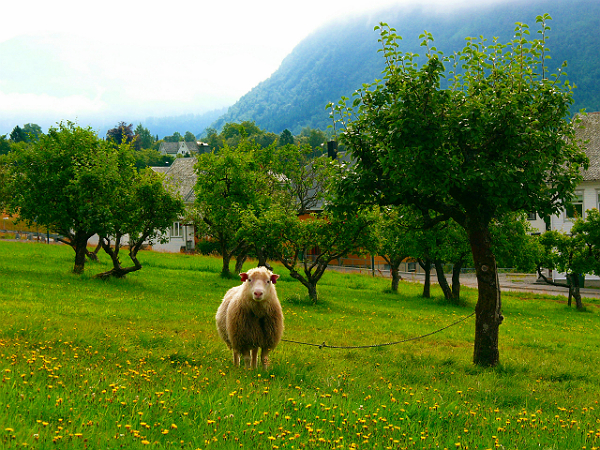
"Are you the teacher from far east?" the sheep asked.
"Yes, I am the teacher," I answered.
"Can I ask you something?" the sheep said.
"Sure, go ahead," I said.
"How is a sheep in the far east like?" the sheep asked.
"Well, it's beautiful, gentle, and tasty!" I replied.
"What?!" the sheep hid behind an apple tree that he was tied to, and looked at me timidly.
"Sorry, just kidding. I'm not going to eat you," I laughed.
The sheep came out from behind the apple tree.
"Do you want to know something more?" I asked.
"Yes, please. Can sheep in the far east really fly?" the sheep asked.
"What? Can they fly??" I asked the sheep back.
"Yes, I heard so," the sheep said.
"I have never seen any sheep flying before... Who said that sheep in the far east fly?" I asked.
"My relative sheep," the sheep answered.
"Did your relative sheep saw sheep flying in the far east?" I asked.
"Yes, he told me so," the sheep answered.
"So your relative sheep has been to far east before?" I asked.
"Yes, he has. Once he was supposed to be exported to England, but a captain of a ship my relative sheep was loaded got too much drunk and lost his sense of direction. One month later the ship ended up in the far east," the sheep explained.
"And there your relative sheep saw sheep flying?" I asked.
"Yes, he said that many sheep were flying in the far east," the sheep answered.
"I haven't heard of any stories like that..." I replied incredulously.
"That's why I asked him if it was true. I also cannot believe it yet," the sheep said.
"By the way, how did your relative sheep manage to talk to you then? Didn't he get stuck in the far east?" I asked.
"The drunk captain fell in love with a woman there and got off the ship. But he was a responsible man he hired a man called Jackie Chan and asked him to take the ship back to Norway on behalf for him," the sheep said.
"I don't know if the captain was responsible when he drank and navigated, though," I said.
"Isn't it a funny name, Jackie Chan?" the sheep asked.
"All the men from far east are called Jackie Chan by western people," I answered.
"So are you Jackie Chan, too?" the sheep asked.
"No, I'm Bruce Lee," I replied.
"Who the baa is Bruce Lee?" the sheep asked.
"Bruce Lee is the man who invented ramen noodles," I answered.
"Oh, I love ramen noodles, they are so delicious!" the sheep said.
"Have you had ramen noodles before?" I asked.
"Yes, there is a good ramen shop in Norway. It's called Famous Jackie's Ramen," saying so the sheep licked his chops.
"I think the man who was hired by the drunk captain started the shop," I talked to myself.
"Can you cook ramen noodles?" the sheep asked me with anticipation.
"Yes, I can. I will cook it for you one day," I winked at the sheep.
"Really?? Hurray!!" the sheep jumped up and down with excitement.
"Okay, I'm slowly going now," I said.
"Oh, it was nice talking to you," the seep responded.
"Let me ask you one more thing before I go," I said.
"Yes, please," the sheep said.
"Why are you tied to the apple tree? I saw other sheep walking freely," I pointed at the apple tree.
"Because I'm badass," the sheep answered with a serious look.
"You mean you do like breaking rules or chasing other sheep away or kicking your owner's leg?" I asked.
"No, no. I do nothing bad like that. I just stole money from my owner to join a fjord tour," the sheep said.
"That's a bad thing!" I responded in surprise.
"No, it's not a bad thing to steal money from my owner," the sheep calmly said.
"What are you talking about? Stealing a thing from anybody is a bad thing!" I told the sheep.
"No, no. A bad thing is when you steal food which is hidden by a crow. Oh, it's terribly bad!" the sheep screwed up his face.
"Gosh, I started feeling dizzy," I held my head.
"Are you okay?" the sheep asked anxiously.
"I hope so... So you mean that you can't steal food from a crow, but you can steal money from your owner," shaking my head I asked.
"Ah, I see. You misunderstand something. When you secretly take food away from a crow, then you "steal". When you secretly take a thing away from the rest, then you "share"," the sheep answered.
"But you clearly used the word "steal" when you told me what you did to your owner!" I responded desperately.
"That's your impression, not my reality," the sheep told me in a sympathetic manner.
"You know what? I feel like our conversations are completely nonsense, or if any chance deeply philosophical. The problems is that I cannot judge it anymore!" I said hopelessly.
"Do not worry, stray sheep. When you deny what I said then our conversations are all nonsense. If you accept what I said then our conversations become deeply philosophical," the sheep said in a didactic tone.
"At last... Can you please tell me why a crow is so special? Do you love a crow?" I asked God, no, the sheep.
"Do I love a crow? Hell no! I hate a crow, A crow is not nice!" the sheep said in disgust.
"You don't make any sense to me!" I almost cried.
"Do you complain about me?" the sheep responded.
"Well, I just cannot follow all of what you said now. I'm so confused..." I collapsed to my knees.
"Listen. Do you think I have made sense to you from the beginning of our conversations?" the sheep gently asked.
"You have not," getting little calmer I replied.
"Then why do you blame on me at the end of our conversations?" the sheep asked me with his merciful eyes.
"I don't know... Maybe I just want to know the truth," tears rolled down my face naturally.
"Do not be afraid, the truth is always within yourself. Love thy neighbor. Do not steal (from a crow). Be light, be love," a halo shined over the sheep's head.
"Amen!" I shouted at the Lamb.
A story from a mild autumn afternoon.
(photo & story by Tengyo Kura, Volda)
Story 21
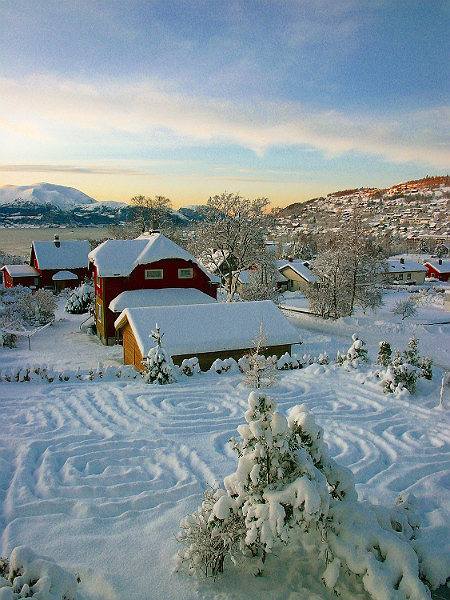
”Volda is the place you'll never forget.”
It is a slogan of a university college in a small town in western Norway.
When I was scattering my CV to colleges around the world to find a teaching job after Sri Lanka, one woman called me from Norway.
"Are you serious about coming to Norway?"
She asked.
"Yes, I am."
I answered.
Eight months later, I was in the beautiful sunny weather of Norwegian late summer.
Outside was still too bright to sleep at 10 pm.
Everything at a supermarket was too expensive to me having lived in Sri Lanka and Mongolia before Norway.
Anyway, it was a very peaceful community and people were mostly friendly and kind to this stranger.
In the first week I stayed at a student dormitory then moved into a wonderful house of a lovely family.
The little brothers of the family were very talented in art and culture.
They already knew how to compose music and play various instruments when they were elementary school students.
I still have their music CD they gave to me.
Because I gave my lectures in English, many of international students took my courses while they were not able to study in Norwegian.
By the time I left Norway after four years, I had made good friends from Europe, Asia, and Africa.
Every season in Norway was beautiful.
Countless colorful flowers bloom everywhere in spring, eternal sunlight shines the world in summer, tranquil peaceful atmosphere fills the air in autumn, and vivid white snow covers the land in winter.
I still remember what one of the international students from Kenya told me.
"In Kenya, the sun rises at 6 am no matter which season it is. I got used to wake up to the sunrise. Here in Norway, what time the sun rises depends which season it is. My problem, or all of the Kenyan students' problems is that we are always late for class when the sun rises after our first lesson. Our Norwegian teacher never understands why we cannot fix the problem, the Kenyan way of life is strongly ingrained in our body."
Every Thursday a local meal called Potato Balls was served at the canteen.
Potato Balls are made of potatoes literally.
Mashed raw potatoes and cooked ones are mixed and shaped as a ball and a small piece of meat is put inside then boiled until caked.
Side dishes are usually salted sheep meat, pork sausages, and mashed yellow cabbages.
Potato Balls are heavy, even a big Norwegian man generally eats two, or three at maximum.
Since I loved Potato Balls, I always ordered four potato balls that was not in a menu. (small is one potato ball, medium is two, and large is three)
One time, when I ordered four potato balls as usual, a woman behind me in a queue stared at me in wonder and said "Do you understand what you are doing?"
By the way, I came to know that many people from Oslo do not like Potato Balls since it is a typical western Norway's local cuisine and Oslo people do not get used to it.
I made a school record of eating seven potato balls in one dish.
Eventually I became known as Mr. Potato Ball among my colleagues and students.
When I was leaving Norway, I made a European tour and visited my friends who I met at the university college.
Norway was a gateway to Europe to me.
Once I had a student from Latvia.
She taught me how to dance waltz at a international students' party.
I didn't expect myself to be able to dance waltz before, but she was very good at teaching, and I became able to dance waltz with her shortly.
Remembering this experience, I developed a will to live in Latvia, and two years later I moved to Latvia.
Living in the small beautiful town truly changed my following life.
And the slogan "Volda is the place you'll never forget," was true to its saying to me.
(photo & story by Tengyo Kura, Volda)