
Story
Story 80
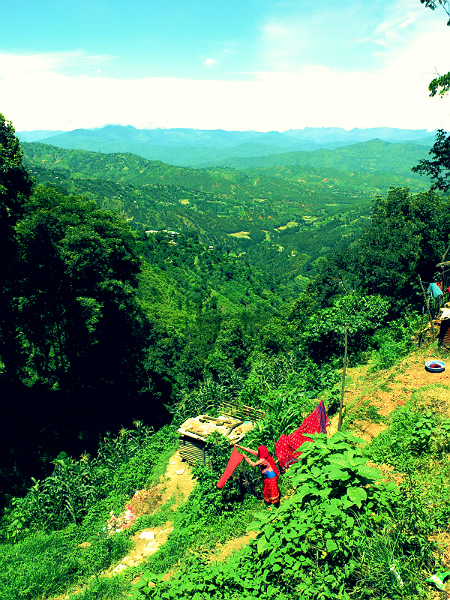
"Look. She is a very rich person."
Pointing at a woman drying her clothes down the slope, my Nepalese friend said.
The clothes seemed nice, but her house and other equipments were very simple.
I did not see any difference between her house and household goods and other families' ones in the area.
"I'm not talking about material richness," he saw through me.
"Look at the landscape carefully. Her place is located right in the middle of the path of the wind from the Himalayas. The wind travels all the way from the divine mountains collecting stories of spirits on its way."
He and I watched the path of the wind in silence for a while.
The woman finished drying her clothes and went back to her house.
Her vivid red clothes were waving in the wind.
Now it seemed like the clothes were listening to stories of the wind from the Himalayas.
I understood what my Nepalese friend meant.
(photo & story by Tengyo Kura, Unknown Location)
Story 79
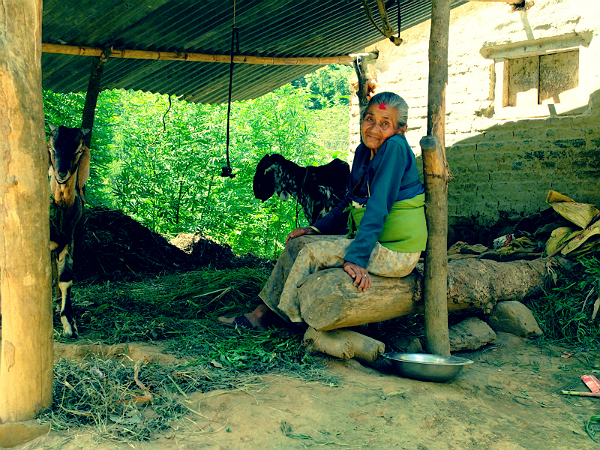
The back yard of the elder woman was full of naturally-growing hemp plants.
I had met some people who claimed that Nepalese cannabis is the best in the world before.
The woman was confused when she saw me getting excited in front of the hem plants.
"I don't know what to do with them. They are too many. I give them to my goats sometimes," she sighed.
"Oh, your goats eat them?" I looked at her goats.
"I wish I were your goat," I almost said that but held it back.
(photo & story by Tengyo Kura, Namo Buddha)
Story 78
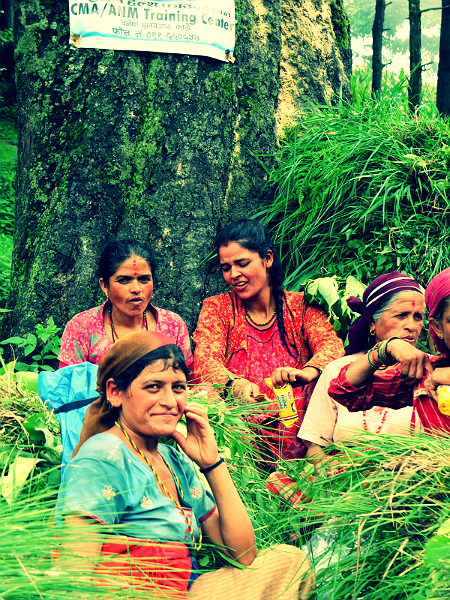
A bunch of women were resting under a tree before heading to their village.
They were carrying big bundles of grass.
"It must be tough to carry them and walk for many hours," I said.
"Yes, it's tough. But we're tough, too," one woman replied.
"A man like you won't be able to walk for even one hour," she continued and laughed.
Another woman said that she liked the smell of grass, and it made carrying grass easier for her.
"I'm so glad that the grass doesn't smell like my husband's feet," she laughed joyfully.
We all laughed together.
(photo & story by Tengyo Kura, Namo Buddha)
Story 77
“Be careful if you enter this lane, wanderer!”
An old lady sitting on the street talked to me when I was about to go into one interesting alley.
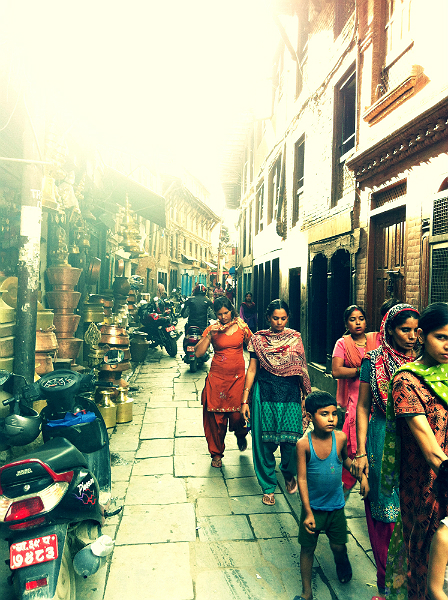
She continued “You will pass a group of women on this lane. If none of them noticed you, then you will gain something. If any of them noticed you, then you will lose something. Be careful!”
I wasn’t sure if I should believe what she said, but with putting my hand on my heart, I thanked her anyway, and went into the alley.
Soon I saw one group of dressed-up women coming towards me.
At that time, I realized that the old lady wasn’t joking.
That meant, not to be noticed by them was only my option to avoid losing something.
I held my camera in front of my face, and tried to look like an ordinary tourist.
Fortunately, they all were busy walking, and some of them were paying their attention to their children.
I was praying while they were passing by.
One passed, two passed, and the rest of them passed by.
I thought that no one saw me, and felt relieved until I checked a picture I took…
After a little while of hesitating, I turned back, and got out of the alley.
The old lady was gone already.
I didn’t feel like going back to the alley again, and went home.
She was right after all.
I definitely lost something; the opportunity to enjoy waking down that interesting lane.
(photo & story by Tengyo Kura, Katmandu)
Story 76
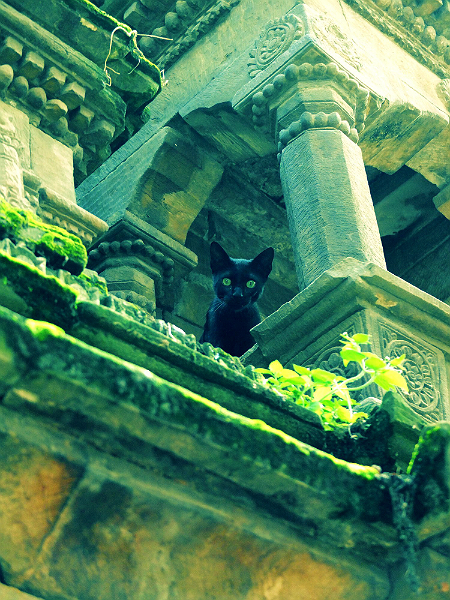
"Who are you? Are you going to feed me?"
The tiny black cat excitedly asked.
"I'm a vagabond. I have nothing to share with you."
The vagabond replied with sympathy.
"Huh? No food?"
The tiny black cat said incredulously.
"Sorry..."
The vagabond shrugged his shoulders exaggeratedly.
"I'm hungry!"
The tiny black cat said reproachfully.
"I'm hungry, too!"
The vagabond said pitifully.
"Who feeds you?"
The tiny black cat asked with an innocent look.
"My families and friends."
The vagabond answered honestly.
"Are you living day to day?"
The tiny black cat asked again.
"Mostly yes."
The vagabond replied and gave a sigh.
"When you pass here next time, call me. I will share my food with you if I get something."
The tiny black cat gave him a look of commiseration and said.
"Really? Thank you! So you would like to be my friend?"
The vagabond delightedly said.
"Your friend? Enough of your jokes! Who want to be friends with a useless one like you! I just want to feel how it is to feed someone, because I have only been fed in my life. That's just what I want!"
The tiny black cat made a nasty smile and disappeared.
"OMG... You hurt me so much, this little kitten! Listen, I am not going to let you feed me. I am the one who feeds you, and you will know that I am not a useless one buy yourself! Tomorrow I will bring you a big fish that you can't even finish half by next day! Don't you forget!"
The vagabond madly shouted and left.
"It's so easy to get food from a guy like that."
The tiny black cat lied down and purred.
(photo & story by Tengyo Kura, Kathmandu)
Story 75
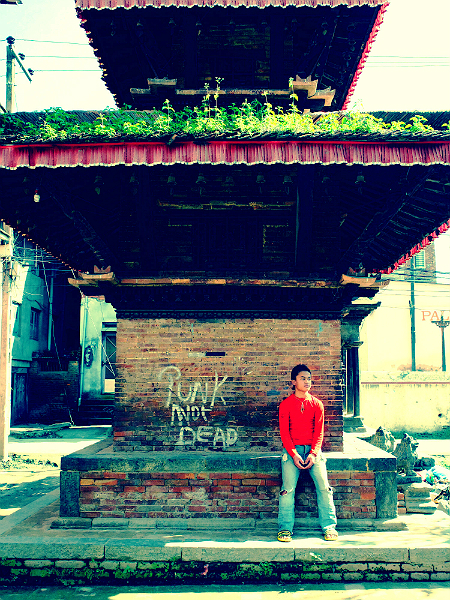
Punk is the youthful soul.
In this kingdom, soul reincarnates.
Hence, they say loud “PUNK NOT DEAD.”
(photo & story by Tengyo Kura, Katmandu)
Story 74
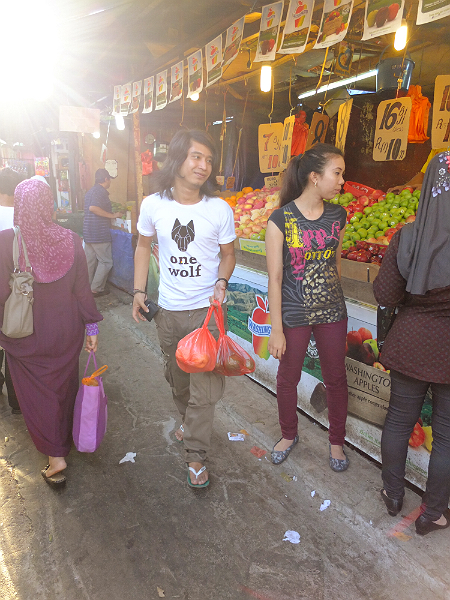
Adam was a central figure of young Malaysian activists.
He did not care about it, but he was nearly worshiped as a new leader of the state among college students in Malaysia.
He is always modest, but his passion in fighting against social injustice has been always blazing like fire.
Adam was the one who took care of the base of the young activists every day, so he became one of the closest friends while I was staying there.
He sometimes took me to local markets where everything was fresh and affordable.
"There are more and more big shopping complexes and malls coming to Malaysia. They sell lots of fancy stuff, but they are not reasonable to everyone. I don't think it's democratic," he said.
Once I asked him what he and the other activists were going to do when the corrupt government of the day was gone when we were having lunch at a local kitchen.
"Why we are fighting against the government is not because we hate them. It's because they are not doing right things for people. So when they are gone and the new government begins, we will keep our eye on them, and if they do wrong things, we will again fight for justice," his statement was strong, but his voice was gentle as usual.
Before leaving the kitchen, one young man approached us, and conveyed Adam that he admired for what Adam had done to Malaysian society.
After the man went, Adam looked at me and smiled shyly.
He is surely inspiration to many people including me.
(photo & story by Tengyo Kura, Kuala Lumpur)
Story 73
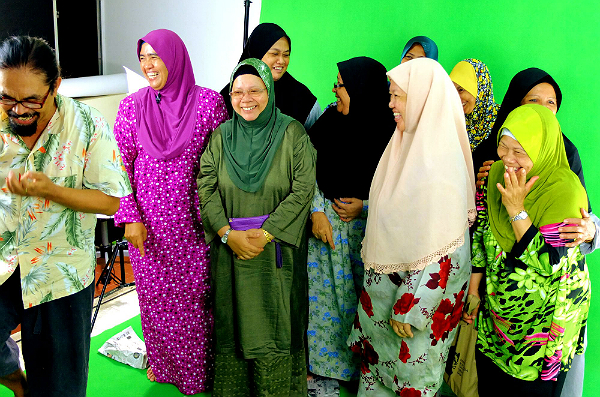
One evening a bunch of women gathered at the base of the young activists.
Rais and the fellows were going to make a short film about the women.
Gender discrimination has been a big issue of Malaysian society.
One of the young activists told me that their goal was not only to overthrow the dictatorial corrupt government.
He said that they were challenging all the social injustice.
Rais and the young activists were the embodiment of human conscience.
With my utmost respect to what Rais and the young activists have done, I write this to our international society where we can love and respect each other with our intelligence and passion.
"What’s happening in our society is what we are.
We are never bystanders of discrimination continuing or a war happening on the other side of the globe.
We are hatred, and we are peace.
What matters is not our society, not our country, not our history.
It’s just each and every one of us."
(photo & story by Tengyo Kura, Kuala Lumpur)
Story 72
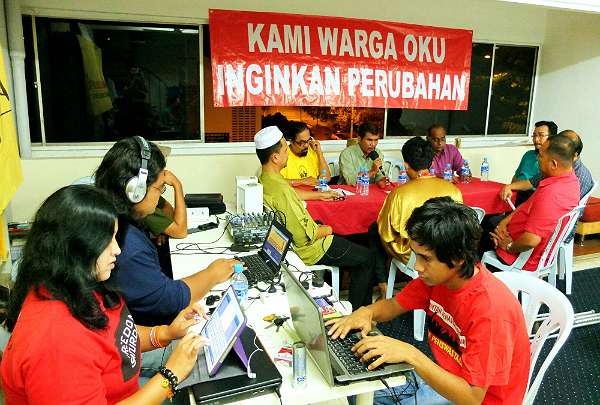
One day, Rais and the young activists invited people in different abilities, and discussed about their problems in society.
Internet radio was their powerful tool to share messages without being censored by the government.
They broadcast the discussion and conveyed what socially vulnerable thought and what problems they faced to society.
Malaysia is multiethnic state, and there are difficult problems to solve among different races.
Rais and the young activists understood that it was not easy to make a society that was perfect to everybody.
They constantly visited or invited social minorities and vulnerable and communicated with them to know their problems.
That required slow and steady effort, and they were willing to take the challenge.
What I learned from Rais and the young activists was that I should not give up listening to people who have different belief and opinions to understand their way of living without judging them.
Diversity and social inclusion sound fancy, but reality is based on each of our daily effort to make no judgment and no self-justification within our mind.
(photo & story by Tengyo Kura, Kuala Lumpur)
Story 71
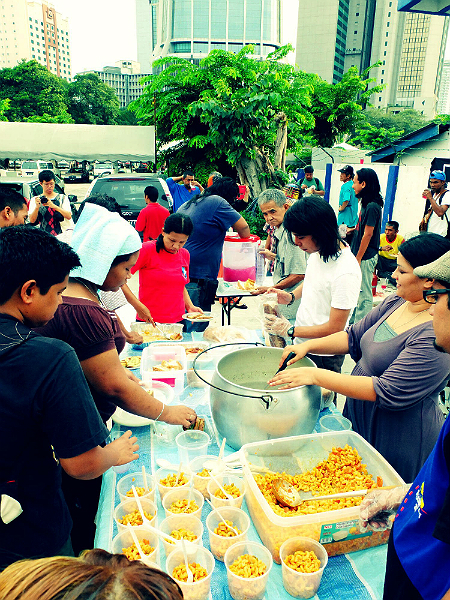
One day, the young activists served meals to homeless people in an old district in Kuala Lumpur.
That district had many buildings that were ideal to shelter from the weather for homeless people, but by lawless land development of the then government those buildings were all demolished.
The young activists did their soup run there and demonstrated to society that so many homeless people actually lost place to go now.
Sharing food with those who were in need, and sharing reality with society peacefully and effectively.
Hats off to them.
(photo & story by Tengyo Kura, Kuala Lumpur)